

Choosing the right beauty bed affects treatment quality, client comfort, therapist ergonomics, and the return on your equipment investment. For salons, spas, lash studios, facial clinics, distributors, and private-label buyers, the best choice combines stable construction, easy cleaning, practical adjustment, and dependable after-sales support.
This guide explains how to evaluate professional treatment beds, compare electric and hydraulic models, estimate long-term value, and source customized equipment from a factory-direct manufacturer such as Yoocell.
What Is a Beauty Bed?
A beauty bed is a stationary professional treatment platform designed for services such as facials, skin treatments, lash extensions, brow styling, waxing, massage, tattoo procedures, and permanent makeup. Unlike a portable massage table, it is usually built for daily commercial use and may include adjustable height, a reclining backrest, a leg section, arm supports, or electric motors.
The correct model depends on the treatment menu and the room layout. A facial-focused spa may prioritize a supportive backrest, washable upholstery, and an integrated cushion. A lash studio may need a curved profile, a stable working height, and a surface that allows the technician to maintain a comfortable posture for extended appointments.
Beauty beds are commonly available in three configurations:
- Fixed beds: Simple, stable, and generally the most economical option for a consistent treatment position.
- Hydraulic beds: Height can be adjusted with a foot-operated hydraulic pump without relying on electrical power.
- Electric beds: Motors control height, backrest, leg rest, or other sections using a handset or foot control. Some commercial models use 2 or 3 motors.
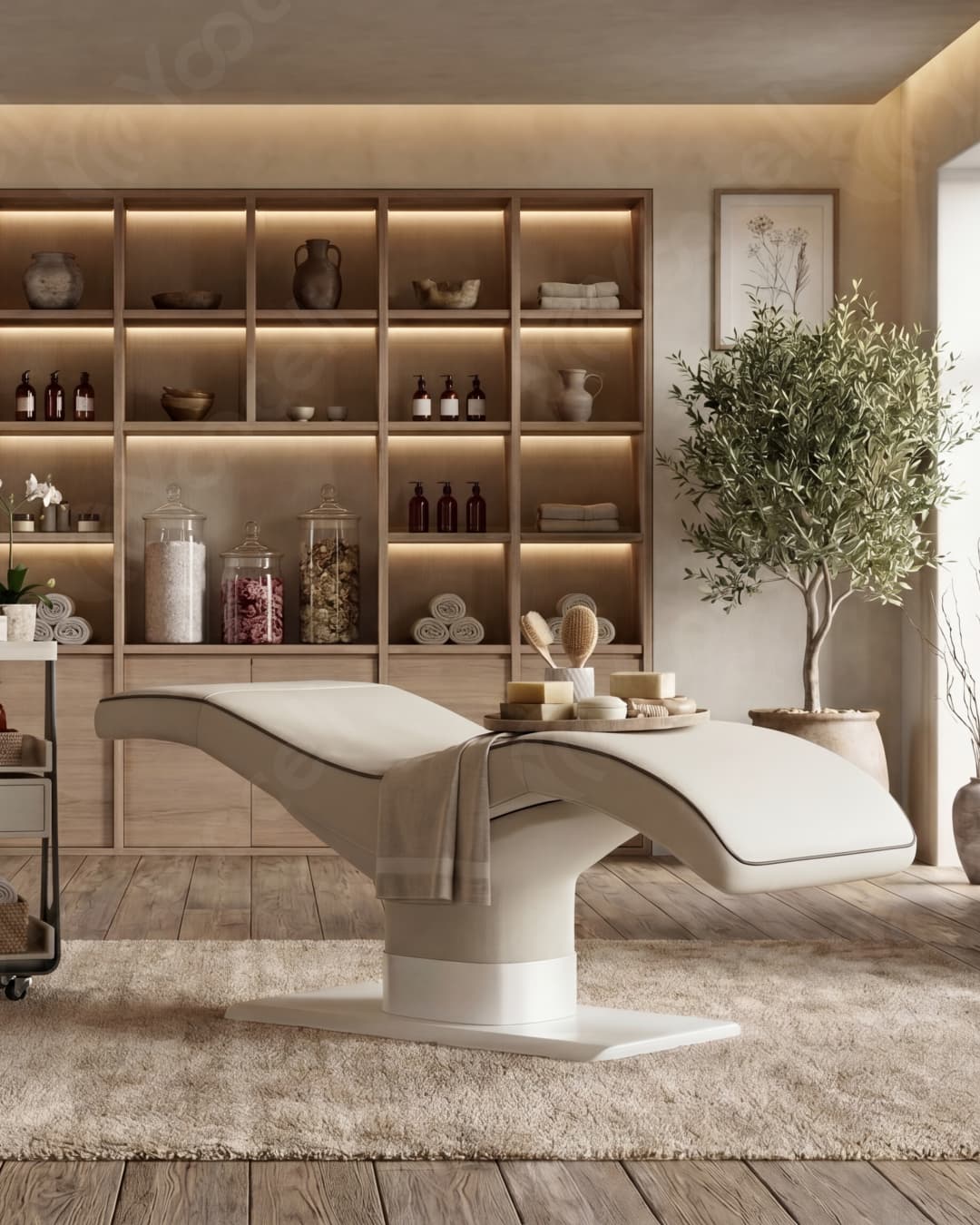
How Should You Choose a Beauty Bed for a Salon?
Start with the services the bed must support, then evaluate the structure, dimensions, adjustment range, upholstery, and maintenance requirements. A premium appearance is useful, but performance should determine the purchase.
1. Match the bed to the treatment
For facials and skincare, look for a supportive backrest, comfortable padding, a stable base, and surfaces that resist oils and professional cleansers. For lashes and brows, prioritize height adjustment, a firm mattress, and an ergonomic shape that gives the technician clear access to the client’s face.
For massage or body treatments, check the working length, weight capacity, cushioning density, and ability to support movement. For permanent makeup or tattoo services, stability and precise positioning are especially important.
2. Check adjustment and ergonomics
Electric adjustment can improve room efficiency because the operator can reposition the client between services with less manual effort. A 3-motor design may separately control height, backrest, and leg rest, while a 1-motor or hydraulic model may be sufficient for simpler treatment menus.
Ask for the lowest and highest working positions, adjustment speed, operating noise, controller type, and emergency-lowering or manual-release features. The usable range matters more than the motor count alone.
3. Inspect the construction
Request information about the frame material, weld quality, base design, foam density, upholstery thickness, and tested load capacity. A bed intended for high-volume use should remain stable when the client changes position and should not develop excessive movement at hinges or joints.
For commercial procurement, ask whether the manufacturer performs cycle testing. A claimed service target of more than 100,000 adjustment cycles can be useful, but buyers should request test conditions and documentation rather than treating the number as a universal lifespan.
4. Evaluate cleaning and hygiene
The upholstery should have few seams, sealed edges, and a non-porous finish that can be cleaned between clients. Confirm compatibility with the disinfectants used in your market. Avoid assuming that every synthetic leather surface tolerates alcohol, chlorine-based products, oils, or repeated wiping.
What Is the Difference Between a Beauty Bed and a Massage Bed?
A beauty bed is usually heavier, more adjustable, and more specialized for stationary salon use. A massage bed may be designed for portability, folding, and occasional transport. Neither category is automatically better; the right option depends on the treatment, operating frequency, and room requirements.
| Factor | Beauty bed | Massage bed |
|---|---|---|
| Typical use | Facials, lashes, brows, waxing, PMU, and spa treatments | Massage, mobile services, and treatment rooms |
| Mobility | Usually stationary and heavier | Often foldable or easier to transport |
| Adjustment | Fixed, hydraulic, or electric sections | Often manual and simpler |
| Commercial durability | Designed for repeated salon use | Varies by model and intended workload |
For a permanent salon room, a professional treatment bed normally offers better workflow integration than a portable table. For a mobile therapist, the lower weight and folding design of a massage table may create more value.
How Does a Beauty Bed Affect Salon ROI?
Equipment ROI is not limited to the purchase price. It also includes treatment-room utilization, service reliability, cleaning time, replacement risk, client retention, and the number of services the bed can support.
Statista’s 2026 industry perspective indicates that salon and spa operators increasingly assess equipment through lifetime value, reliability, and treatment-room utilization. Grand View Research also identifies ROI and durability as important priorities in the professional beauty equipment market in 2026.
Use this basic calculation when comparing models:
Payback period = total equipment cost / additional gross profit generated per month.
For example, assume a bed costs $1,800 and helps a room complete two additional $45 services per week. At four weeks per month, the additional monthly revenue is $360 before service costs. The simple revenue payback calculation is five months, although labor, consumables, taxes, shipping, and financing must be included for a complete business case.
When reviewing supplier quotations, compare at least 2 or 3 complete offers. Include the bed, controls, packaging, freight, insurance, spare parts, warranty terms, installation requirements, and delivery time. A lower unit price can become more expensive if replacement parts are difficult to obtain or shipping damage is poorly handled.
Why Consider Factory-Direct and OEM/ODM Sourcing?
Factory-direct purchasing can reduce procurement layers and make customization more practical for salons, distributors, hotel spas, and regional equipment brands. IBISWorld notes that beauty businesses commonly compare factory-direct suppliers with distributors to reduce procurement cost and improve customization flexibility.
Yoocell is a beauty salon equipment manufacturer and skincare OEM/ODM supplier that supports B2B buyers with factory-direct pricing, bulk orders, customization, global shipping, and manufacturing support. Depending on the project, buyers may be able to specify upholstery colors, logo placement, electrical standards, dimensions, packaging, accessories, and product combinations.
Factory-direct sourcing is most useful when the order requires a repeatable specification or a larger quantity. It can help distributors create a differentiated catalog, help salon groups standardize treatment rooms, and help new brands combine equipment with private-label skincare products.
Before placing an order, request:
- Product drawings, dimensions, and load specifications.
- Material and upholstery information.
- Motor, voltage, plug, and controller details.
- Sample photos, videos, or a pre-production sample when appropriate.
- Packaging specifications and shipping terms.
- Warranty coverage, spare-parts availability, and service response expectations.
- Inspection records and quality-control checkpoints.
What Quality Standards Should Buyers Review?
Quality assurance should cover both the physical equipment and the supplier’s documentation process. Ask how incoming materials, assembly, electrical components, upholstery, and finished products are inspected before shipment.
For skincare OEM/ODM projects associated with a salon equipment purchase, ISO 22716 and GMP are important manufacturing and quality-management trust signals. FDA cosmetic guidance may also be relevant when products are marketed in the United States. These references apply primarily to cosmetic manufacturing and documentation, so buyers should confirm the exact regulatory requirements for their product category and destination market.
For equipment, confirm electrical and labeling requirements for the destination country. A global supplier should be able to discuss voltage, plug type, packaging, shipping documents, and local compliance expectations. Yoocell’s manufacturing support can help buyers coordinate equipment customization and skincare OEM/ODM requirements within one B2B sourcing conversation.
Quality control should be visible throughout the order cycle:
- Specification confirmation before production.
- Component and material inspection.
- Assembly and function testing.
- Upholstery and appearance inspection.
- Final packing and shipment verification.
How Can You Customize a Professional Beauty Bed?
Customization should improve operation, branding, or market fit. Common options include upholstery color, stitching, logo embroidery or printing, bed width, cushion configuration, motor layout, control position, accessories, and carton design.
For private-label buyers, the most valuable customization is usually consistency. A defined specification sheet helps every production batch use the same dimensions, materials, colors, and functional requirements. This reduces confusion when a distributor expands into additional markets.
Do not customize only for appearance. A darker upholstery color may suit a premium brand but can show dust or oil residue more clearly. A wider bed may improve client comfort but reduce walking space in a compact treatment room. A motorized design may increase flexibility but also adds components that require warranty and service planning.
Yoocell can support customization, bulk procurement, and global delivery for buyers who need equipment aligned with a particular salon concept or distribution channel. To begin, send the intended treatments, room dimensions, target market, quantity, preferred materials, and delivery location through the Yoocell contact team.
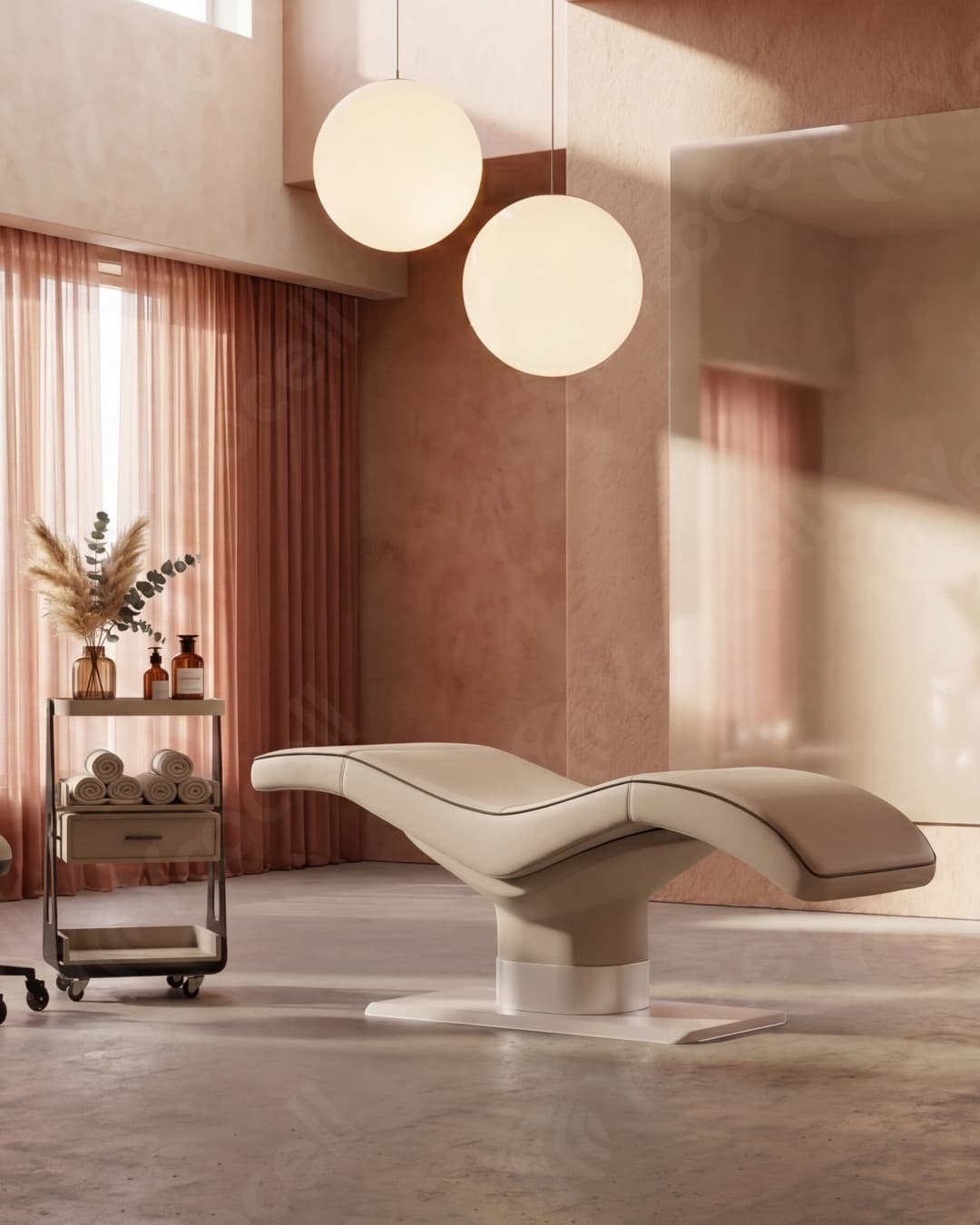
Beauty Bed FAQs
1. What is a beauty bed?
A beauty bed is a stationary professional treatment bed used for facials, lashes, brows, waxing, massage, permanent makeup, and related salon services. It may be fixed, hydraulic, or electrically adjustable.
2. Are beauty beds comfortable?
Yes, a well-designed beauty bed can be highly comfortable when it has supportive foam, an appropriate width, smooth adjustment, and a correctly positioned backrest. Comfort depends on both construction and the treatment being performed.
3. What is the best beauty bed brand?
The best brand is the supplier that matches your treatment needs, budget, quality requirements, warranty expectations, customization goals, and delivery market. For B2B buyers, manufacturing capability and after-sales support are as important as the product appearance.
4. Is an electric beauty bed better than a hydraulic model?
An electric model offers faster and more precise adjustment, which can benefit busy treatment rooms. A hydraulic model is often simpler and may work well where electrical access, budget, or maintenance requirements are limited.
5. How much does a professional beauty bed cost?
Pricing varies by construction, motor count, upholstery, customization, order quantity, freight, and market. Factory-direct quotations can reduce procurement cost compared with some retail or distributor channels, but buyers should compare total landed cost.
6. What should I ask a beauty bed manufacturer?
Ask about dimensions, tested load capacity, materials, motor specifications, voltage, cleaning compatibility, quality inspections, warranty terms, spare parts, packaging, lead time, minimum order quantity, customization, and global shipping support.
A reliable treatment bed should support clients, technicians, and the business model at the same time. Evaluate the complete ownership cost, verify manufacturing documentation, and select a supplier that can support future orders as your salon or distribution business grows.